
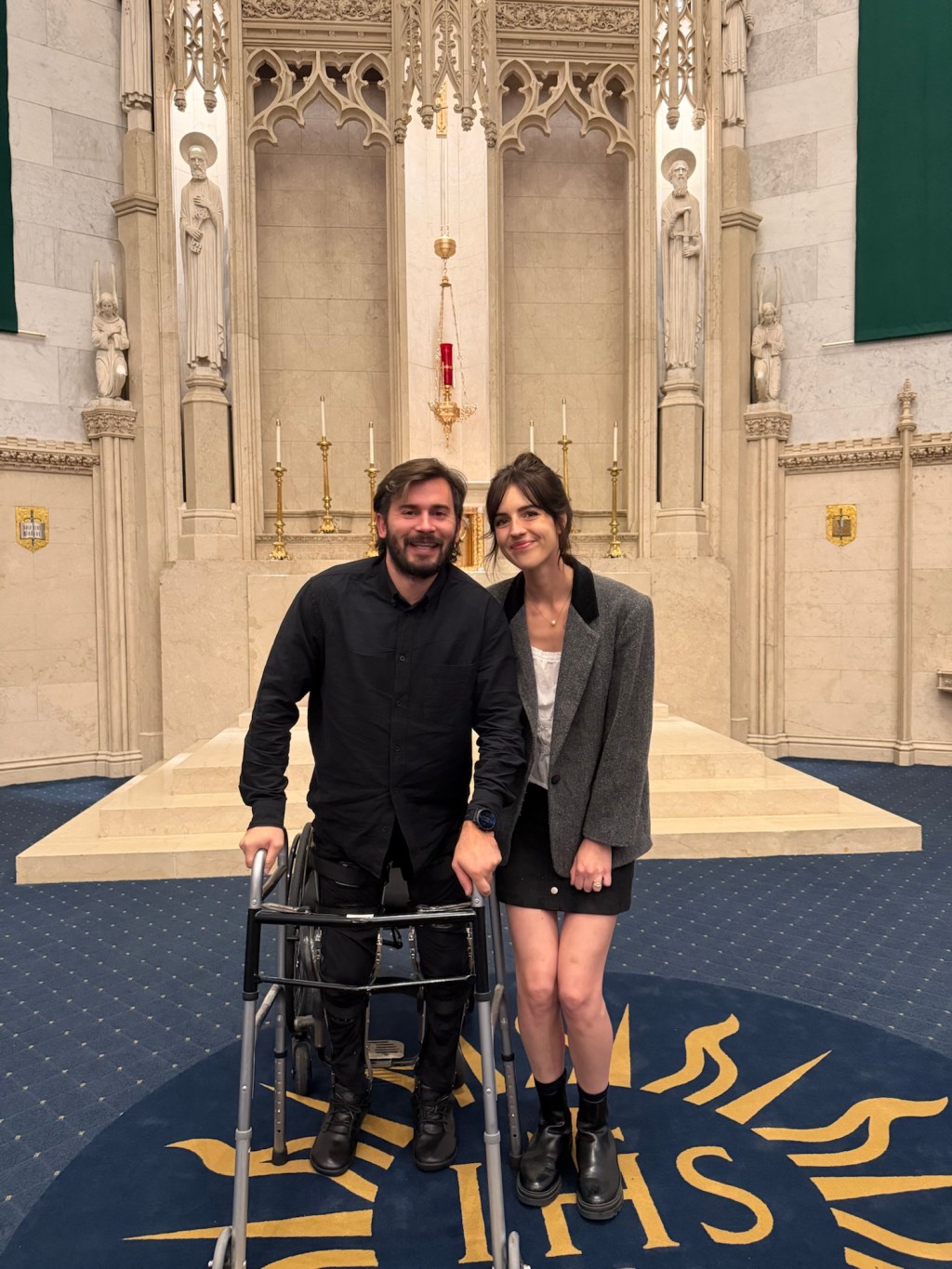
9/13/26 – Outside Walking Round 2!
HOLEE SMOKES!! The change in sensations in my body!! Low back and hips and firing like none other! Low abdomen is charged up!!! Lats are evening out! Glutes are firing, from the top to the bottom of these fellas! QUADS ARE JOINING THE PARTY!! Knees are tight and filling in! Hamstrings are softening! Gastroc’s are FULL! They feel like I got leg warmers / high socks on! Soleus and ankles feel like I got ankle weights on!! Tin anterior is buzzing with life!
These FEET! From my heels, to all the meta tarsals, bed of my feet, ball of my feet, toes! Goodness gracious is this a huge wake up for the crew down there! Everyone is joining the party this morning!
Getting that walk in outside, on the road, with the crown of the road and uneven surfaces is making my body adapt and learning how to handle uneven surfaces! I know these rods are there, but I need to get this pelvis to tilt and move to accommodate for the natural variations that are the world around us! I figure I just gotta do it! Callie helped me out yesterday and I made some decent distance!! It was a great walk!!
Busy day! Working on home!
Standing frame!
Walk outside! Now time for some rest!
9/14/26 – Nighttime Changes
Okay this was huge! My left hip flexor is relaxing and this left leg was straighter than ever!! This was amazing!! Great feeling to wake up to!
I had this thought, through our muscles in our legs, what is the “quickest path to ground”? Is this typically the agonist muscles? I know this changes in whichever position we are in, but maybe there’s something to this path and how the nervous system signals travel through our body? I’ll have to look into this!
Pretty pleased with the daytime presence of my legs! Gotta keep up the progress with these boys!
All these Micromovements, focused attention, and small little details throughout my day I can feel how they all matter, and make such a difference in how my legs are responding. I don’t treat em as if they aren’t there. I am constantly adjusting, putting more weight thru my feet, and trying to stabilize more and more thru my feet! I gotta just keep up the work and expose my legs to more situations!
Another good PT session! So much to do tonite still!
Geez Luis!!! I was working on this speech till 10:30 tonite! My body is exhausted, famished, and ready to chill the heck out! I need some rest! More on all this tomorrow! But boy are my legs really getting it today!
9/15/26 – More Time Upright!
Tried to eke out a few more minutes of sleep today! I think yesterday was a huge day for movement, and my legs are feeling FULL today! Less sweating, more extension and baseline muscle activation, everywhere is filling in!
WOW WERE MY LEGS ACTIVE ANS FULL TODAY! I had an amazing time today feeling so much activation from them! It’s incredible! Honestly it’s astounding, I can’t believe them sometimes!
9/16/26 – Fractionate!
The push and the pull on my body right now laying supine? This requires my whole body’s involvement and care. Coordinating my breath, my attention to the various parts of my body simultaneously, and most certainly where I’m contracting and where I’m relaxing. It’s not easy, and doesn’t always feel good. But I can feel my body slowly, methodically, and carefully working on reconnecting, one breath, one thought, one contraction at a time.
Besides the word co-contraction, is there a word when you simultaneously contract and relax? Because that is what I need to work on? Does this exist?
Fractionate – there it is.
I need to learn more about the muscles in the lower trunk… turns out there’s a lot going on in there and I honestly think we over simplify the muscle group / fascial / tendon relationship in our torso?
What even is “pain”? Like for real? I’m not in danger,
What if “Life” in other planets, isn’t really life like we know at all? Not even remotely? What if it’s something completely outside of the realm of organic molecules and earth biology? Like as in some sort of “anti-life” to what we have here? Where life isn’t composed of organic molecules but is almost existent in not even some physical form? Almost like the internet, but some “organic internet?”
I swear, I feel like the “fullness” and activity in my legs sometimes alternates between the right and the left? Like my right leg right now is more full than my left, and I’m feeling it more as well? Whats up with this?
Tendon elasticity — springs inside our body? Like the springs on the outside of our body?
I guess signals are also traveling thru the fascia, there is something else going on in here that is more complicated than the simple muscle mass body connection that people talk about?
I had quite the walk at PT and then session at Pilates today! My body really needed all that time in extension! Walking, baby chair and pumping, and Cadillac + prone work! This was unreal! My low back is feeling all this increased looseness this evening!
9/17/26 – Repetitive Input Theory / Consistency IS The Intervention
If I could rig up a spring to my leg stretcher, I wonder if I could use it for knee extension? I have this funny feeling, that the tendons and fascia in our body need a certain type of input. And that’s repetitive input? Our body likes to do a lot of movement, in the words of Therese, “I hate the word exercise, that’s why I call it movement”. I think this cyclical repetitive motion does more for our bodies than we know! I mean shoot! I was able to push the baby chair step down, while I was seated on it?! I was looking in the mirror and my back was extending, hips extending, and then it goes down the rest of the chain!?
And this is all done with springs?! Therese calls it the muscles on the outside of our body. But what if it’s actually the fascia, tendons, ligaments, on the outside of our body?
This interesting, ‘tensegrity weave’ that is the fascia and tendons isn’t as well understood, so I think I need to continue to dig into this! There’s something real happening in my body, and I literally am feeling the change, and I am watching and feeling the movement change as well!
Problem is, I still haven’t been able to isolate knee extension very well? So I wonder if rigging up some Pilates springs to my leg stretcher, and maybe a hip belt for the anchor point, could allow me to get some input into my knee extensor muscles?? I need to look up all the tendons and fascia and muscles for knee extension again!
So even if I am able to get the quads and hamstrings to contract, I still need the ligaments, pulleys (if you will), and fascia to still be allowed to move??
I think this is where mental “safety” comes in play? The innervation and role of the ligaments and fascia, is to help keep the joint safe. If it doesn’t get to spend enough time in a position, it doesn’t feel “safe”? Is there any studies on this for fascial and ligament innervation and its role in providing and transmitting safe movement?
So I’m going to have to do some research into this, and I hope it has actual mechanistic backing in here somewhere!
So could it be that ligaments and fascia are genuinely wired for a “safety” role, not just mechanics?!
Some of the research is in ligament and joint mechanoreceptor (which is a fancy name for a sensory receptor) research: ligaments contain:
- Golgi organs
- Ruffini terminals
- Pacinian corpuscles
- free nerve endings
Some of the studies I have found, are saying that these give ligaments significant impact on motor control and a strong influence on the quality of movement, safety and stability of the joint. So if this is in the literal published articles, is there something here??! [1]
So what I’m finding, talking about our bodies physiological control loops, is that the mechanism is called ‘feedforward preprogramming’, not a simple “protect the joint” reflex. Feed – Forward is like when you visually see a hill coming up ahead of you, and your body slows down in anticipation of the steep hill, pretty much.
Research on ligament afferents (signals in the central nervous system) found that the older idea of a direct “ligament is threatened → muscle reflexively contracts to protect it” pathway doesn’t hold up quite as well, and that ligament mechanoreceptors have an important role in muscle coordination and in the reflex regulation of functional joint stability, contributing to the preprogramming of muscle stiffness through modulation of the gamma-muscle spindle system. [1]
Saying it another way: the ligament isn’t waiting to detect danger and then ‘slam the brakes’ — it’s continuously feeding the nervous system information that shapes how “stiff” or “loose” the CNS decides to make the surrounding muscles, ahead of time, based on what position and load history it’s sensed. [2] Goodness this is interesting!
I’ve been learning a lot about fascia! What I’m also seeing, is that fascia also tells a similar story, with an even stronger “sensory organ” framing. Fascia — especially thoracolumbar fascia, which is the best-studied region — is now understood to be highly innervated, with a high density of mechanoreceptors responsible for afferent (internal) proprioceptive information about joint position and movement. And more importantly for my “doesn’t feel safe if it doesn’t get time in a position” idea: What I learned. in populations with chronic pain, that fascia shows pathological alterations alongside measurable proprioceptive deficits, including impaired joint positioning sense — meaning damaged/under-loaded fascia doesn’t just feel different, it actually degrades the accuracy of the position sense being fed back to your brain. [3] Less accurate input plausibly means the CNS defaults to more cautious, guarded output — which lines up with what I’m kinda describing?! [2] [4] Maybe this is also why my hip/ lower left abdominal area is so overactive as well?
What doesn’t exist (yet), as far as I can find: none of this is written specifically for the SCI population. It’s built on low back pain, ankle instability, and elbow/knee ligament research. Nobody seems to have published the specific version of my question — “does time-in-position after SCI change fascial/ligament afferent signaling in a way that reads as ‘unsafe’ to the CNS and produces guarding.” This seems like a real gap!!
It definitely seems like degraded or under-loaded connective tissue → noisier or reduced proprioceptive signal → CNS defaults to protective/guarded motor output, independent of whether there’s any actual mechanical instability???
This is why if I keep all of the work I’m doing up, more time standing, walking, it’s not only strengthening muscles but also teaching the tissue that it’s safe and free to move????
It honestly feels like I am connecting three real threads:
1. Tendon/fascia respond to repeated loading by remodeling toward more elastic, organized collagen — the “spring” property literally gets retrained by use.
2. Ligament and fascial mechanoreceptors feed the CNS continuous data about position and load, which shapes — via that feedforward preprogramming mechanism — how much baseline stiffness/guarding the nervous system decides to apply, before you even move.
3. The protective response hypothesis explicitly frames guarded, stiff motor output as a nervous-system decision based on perceived threat — and threat/safety here isn’t just about pain, it’s about how much reliable, consistent sensory information the CNS is getting. Noisy or sparse input reads as “uncertain,” and uncertain tends to default to cautious.
So more standing time, more walking time, more consistent time in a given position isn’t just mechanical rep-counting for muscle strength — it’s also repeatedly feeding the CNS clean, consistent, non-threatening sensory data from that position, which is exactly the kind of input that lets feedforward preprogramming relax its guarding over time. That’s the same underlying logic behind graded exposure approaches in pain rehab: repeated, safe exposure to a movement or position is what teaches the nervous system it doesn’t need to protect against it anymore!!!
Nobody (or at least what I’ve found) has run the study that says “SCI patient does X hours of standing, tissue innervation measurably updates its threat threshold.”
What I seem to be building is a mechanistic bridge across several separately-established literatures (tendon mechanics, ligament/fascial proprioception, pain-and-motor-control research) — applied to my own case???
This is my own working theory, rather than settled science. I need to keep exploring this idea! I hope I find more studies on this topic!
Which, is why “I haven’t stopped, and my body keeps responding” is what is actually happening??? — it’s actually the mechanism itself, if my synthesis holds. The consistency is the intervention???
Sustained, consistent loading is plausibly both remodeling my connective tissue and continuously updating my nervous system’s threat assessment of these positions….. This is what I need to continue to do! This is what I need to maybe see about testing? This is what it’s all building towards!!
Nobody seems to have connected the SCI-specific neuroplasticity research — from what I have found yet — which shows that proprioceptive afferent input from task-specific loading is necessary for beneficial spinal circuit reorganization — to the pain-neuroscience and fascial-innervation research showing that ligament and fascial mechanoreceptors continuously shape protective motor guarding, where degraded or inconsistent sensory input drives more cautious, stiffer output and consistent input relaxes it.
In other words, nobody has published the version of this that says: after SCI, sustained, consistent loading isn’t just rewiring spinal circuits — it’s also feeding the fascia and ligaments the steady, reliable proprioceptive signal that teaches the nervous system these positions and movements are safe, downregulating protective guarding independently of whatever’s happening at the spinal-circuit level.
This has to be it, this is why continuous inputs and movement matter, not just sitting in my wheelchair and “taking it”!!
That’s the real “thing” or “idea” I just landed on — not “movement is good” as a vague claim, but a specific claim: passive positioning (just sitting) gives the nervous system static, unchanging input, while active, varied loading gives it the continuous, task-specific proprioceptive signal that both drives circuit reorganization AND teaches the tissue it’s safe to move through. Those are two different inputs to the same system, and being upright is the position doing the work I actually need!!
It also retroactively explains a bunch of my own instincts from the last few weeks of observations and notes — why the wheelchair dump-angle changes with Ashley mattered, why the balance disc lit things up, why standing time and walking time in the braces feel different from just existing in the chair. I am not just “doing more exercise.” I am feeding the system the specific kind of input that literature independently say matters!!
3 standing frame sessions today, busy day at work, rounded out the night up here in the standing frame for an hour. Oof this is enough for tonite!! This was a lot of writing, but I have been researching like crazy and wanted to get my notes and thoughts down!
9/18/26 – Nighttime Standing Frame Sessions
Wow, seriously the squeeze, fullness, and proprioception of my entire lower body today is HUGE! Also not sweaty?! The standing frame session last night before bed was good to get the GI tract moving properly to allow for a good nights rest!
These quads are feeling a large amount of fullness! As are the glutes, gastroc’s, and soleus too! My feet’s intrinsic muscles are really alive down there, and all the books and crannies in between my toes are livid with sensation!
In the standing frame last night I was working on a lot of repetitive motion. Circles, counter and clockwise, mini squats, stretching, readjusting, and breath work. It honestly was a good way to round out the night, because then when I got in bed, getting in figure four to stretch supine was always great!
It’s so crazy how my legs every day keep responding!? Let’s keep getting up in the braces, walk farther, and get these quads stronger! Goodness gracious!
9/19/26 – Anniversary & Speech Day!
Anniversary Day!!
Wow! My low back and glutes are fired up and holding my hips in extension!! They’ve fought back the hip flexors well enough to keep them from spasming!!! This is unreal! I can’t believe this!! This is a huge moment, and a big day today! Better get up and get ready!
DID THE SPEECH UP STANDING! I can’t believe I was able to pull it together! What an honor and joy it was to work on! Working on my body, stringing words together in standing, the words of the speech, the whole process was great! It was also cool to have had my Callie there with me for this special moment on such a special day! I really had alot of help and support from her to be able to do this, as well as help from the PTs, and the students who not only nominated me, but helped me with the entire process!
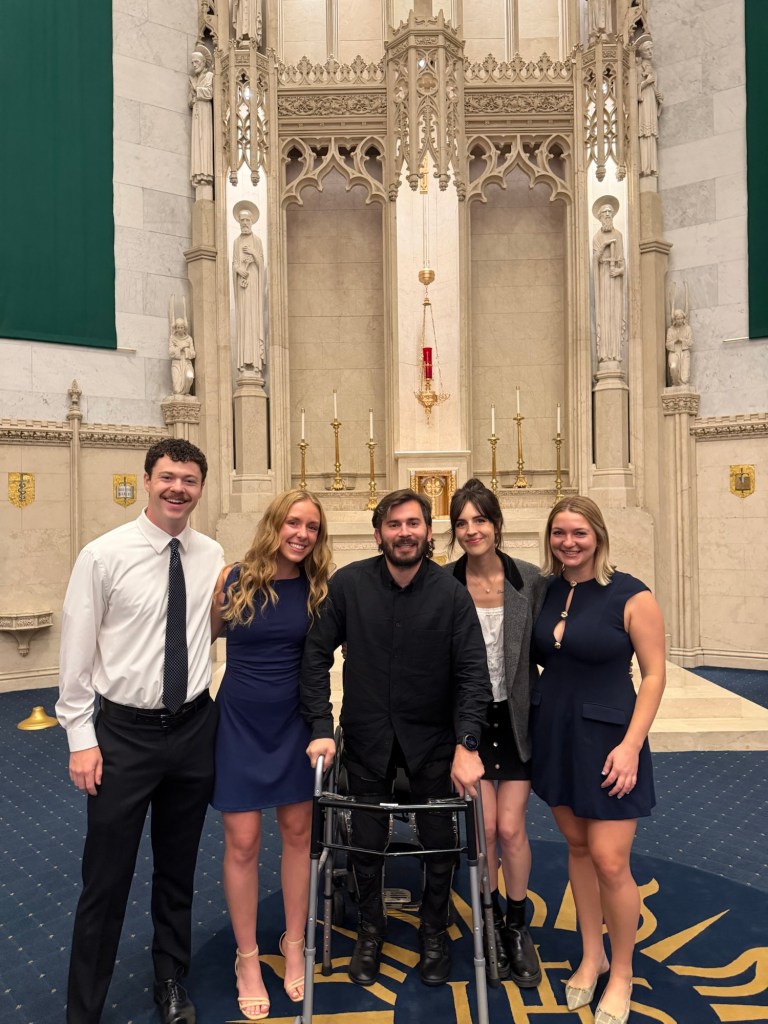
Callie and I had a great day spending so much time together, what a wild way too, to have celebrated our 1 year anniversary!
Link to Video Below!
Joe Does A Speech! – Marquette Pinning Ceremony
Works Cited
1. https://www.sciencedirect.com/science/article/abs/pii/S0363502305804708
2. https://pubmed.ncbi.nlm.nih.gov/12086810/
3. https://link.springer.com/article/10.1186/2056-5917-1-S1-A2


Leave a Reply