
Joseph Reiter — Astronaut on Earth Journal, 9th October 2025
The Stabilizer Cascade Theory
You ever wonder about human muscle development? I have, after my accident and what I’m going through.
For some reason I’m trying to explain, when I’m at Pilates, PT, or at the gym, and I am able to hold my body in a position, to then support my trunk and torso first, I feel safe. On the wall unit at the Pilates, Cable machine at the gym, or on the edge of the mat or floor at PT, they all have some common themes. Get core stable, allow your limbs to feel secure and safe to your body, and the stabilization can build from there.
I’ve been able to notice such significant changes in the mornings, when I wake up, after sessions built around getting this trunk stable, and helping the movement fall into place once the said muscle groups are stable, I feel my core coming and staying online, spinal stabilizers waking up, breath deeper and more organized, and a trickle down of sensations throughout my legs. Everything from my diaphragm to hip flexors, to my psoas, obliques, and glute med and min. Slowly with more trunk activation, I feel more recruitment distally.
This process, I believe, mirrors early human development, where infants progress from deep postural tone to rolling, crawling, kneeling, tall kneeling, mini squatting, and eventually standing. Each movement based on the foundational stabilizers used and developed from the previous form of movement. I have been able to also follow this pattern, inside my own body. First working on my postural tone while seated, in long sit, and variations modified standing positions, to then crawling, tall kneeling, and walking in my KAFOs. All of these movement patterns have required my body to be strong from my torso first, and extremities second.
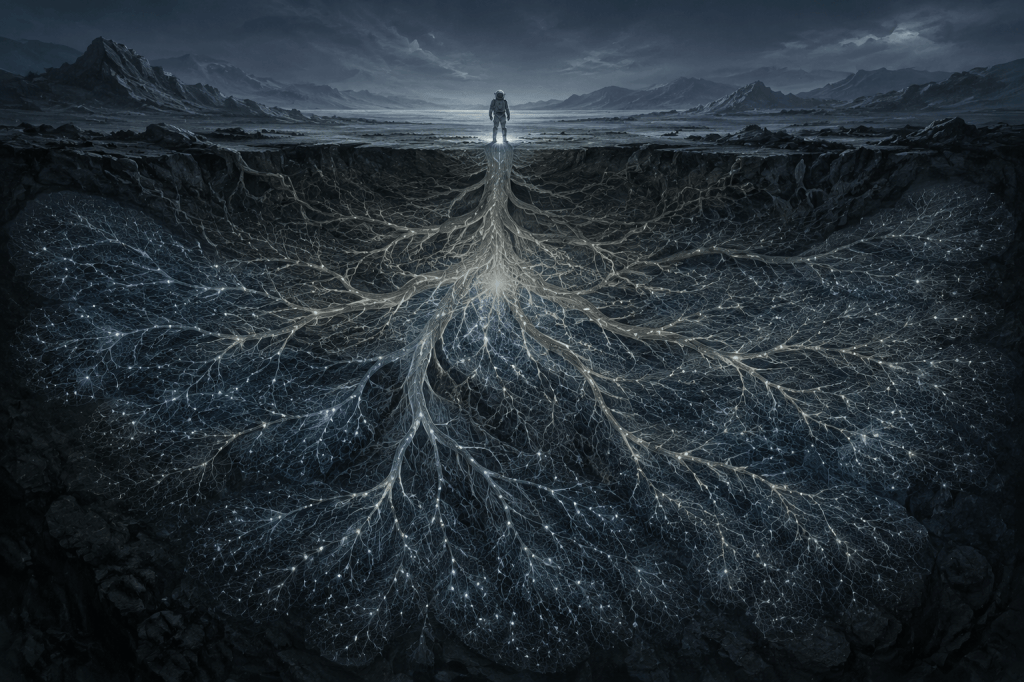
So a name I’ve put to this, ‘The Stabilizer Cascade Theory’, came from how I’ve noticed muscles waking up in my trunk, and then seems to help awaken muscles more distally as I continue to progress in my rehab. This theorizes that recovery and motor reawakening after neurological Injury does not begin with large, visible muscle contractions, but with the subtle, deep stabilizer muscles of the body. Like when I’m doing all my core work at Pilates, edge of mat training at PT. When these small, foundational muscles—particularly those surrounding the shoulders, pelvis, diaphragm, spine, and deep core—reactivate, they generate a neurological “waterfall” effect (for lack of better term) that sequentially reawakens larger, more global muscle groups throughout the body.
Every morning that I wake up and feel “more sensation or activation there,” feels like it’s not random. It feels like the stabilizers are coming online. It’s the nervous system remembering what it means to stand and be useful. I am only a sample size of 1, but these observations seem to be leading to higher function.
“The body doesn’t reawaken in giant leaps and bounds—it’s awoken in small little cascades, compounding over longer periods of consistency and time.”
⸻
Core Ideas / Notes On The Theory
If a muscle or muscle group is even slightly capable of contraction—if there’s any trace signal at all—then the pathway could still exist. These small contractions, small activation is the ignition + reactivation point. Through consistent activation, breathwork, and sensory feedback, and attention, these trace signals amplify into full-scale recruitment with significant repetition.
Main idea:
“If a muscle can twitch/activate or if you feel a trace contraction, it can someday fully contract, leading to someday larger foundational movements, such as larger leg contractions and hopefully full standing as the ultimate goal.”
⸻
Mechanism
1. Foundational Activation — Deep stabilizers + Shoulder stabilizers (transversus abdominis, multifidi, serratus anterior, supraspinatus, subscapularis,, infraspinatus, teres minor, pelvic floor, diaphragm) establish internal tension and alignment.
2. ‘Peripheral Cascade’ — Once the core system stabilizes, proprioceptive and motor signals spread outward and downward—engaging hips, glutes, quads, and calves in sequence.
3. Feedback Loop — Each contraction increases sensory feedback (“feeling more there”), reinforcing neural maps and proprioception.
4. Functional Emergence — Over time, these cumulative signals reconstruct patterns (standing / grasping / stabilizing) and coordinated movement, from micro-movements to larger macro function.
⸻
My Observational Evidence – from personal recovery
• Singing & humming: Engages the diaphragm and pelvic stabilizers, creating vibratory feedback that travels down into the pelvis and legs.
• Magic circle work: Adductor/abductor activation enhances pelvic stability, feeding the cascade upward and downward.
• Side planks, pelvic tilts, and tall kneeling: Sequentially integrate the lateral chain, glutes, and deep core to produce standing readiness.
• Trace contractions observed in legs and hips lead to new sensations, proprioception, and motor readiness sometimes up to days later—suggesting a cumulative neural re-patterning effect.
⸻
Working Hypothesis
The Stabilizer Cascade operates through progressive proprioceptive amplification: the nervous system strengthens whichever circuits it can access, and these small stabilizer activations create the scaffolding for higher-order motor function. As more stabilizers engage, the entire kinetic chain “fills in,” creating a cascade effect that allows muscles further down the kinetic chain to re-awaken/ re-engage.
⸻
Practical Implication
Rehabilitation has potential to not only focus on strengthening, but also on awakening—stimulating small, often overlooked muscles and their sensory pathways, before the strengthening process. Breathwork, diaphragmatic work, and stabilizer-focused movement (Pilates, crawling, kneeling, core engagement) can serve as ignition points for the cascade.
⸻
Works Cited
Motor Control, Stabilization, and Core-First Activation
Hodges, P. W., & Richardson, C. A. (1996). Inefficient muscular stabilization of the lumbar spine associated with low back pain. Spine, 21(22), 2640–2650. → Demonstrates that deep stabilizers (e.g., transversus abdominis) activate prior to global movement, supporting the “foundational activation” concept. Panjabi, M. M. (1992). The stabilizing system of the spine. Part I: Function, dysfunction, adaptation, and enhancement. Journal of Spinal Disorders, 5(4), 383–389. → Introduces the idea of a hierarchical stabilizing system (passive, active, neural), aligning closely with your cascade framing.
Developmental Motor Sequencing & Movement Progression
Thelen, E. (1995). Motor development: A new synthesis. American Psychologist, 50(2), 79–95. → Supports the idea that complex movement emerges from self-organizing systems built on earlier postural control. Adolph, K. E., & Berger, S. E. (2006). Motor development. In Handbook of Child Psychology (6th ed.). → Documents the progression from postural control → crawling → kneeling → standing, reinforcing your developmental analogy.
Neuroplasticity & “Trace Signal” Persistence
Kleim, J. A., & Jones, T. A. (2008). Principles of experience-dependent neural plasticity. Journal of Speech, Language, and Hearing Research, 51(1), S225–S239. → Supports your claim that small, repeated activations strengthen neural pathways over time. Nudo, R. J. (2013). Recovery after brain injury: Mechanisms and principles. Frontiers in Human Neuroscience, 7, 887. → Shows that residual neural signals can be amplified with repetition — key to your “trace contraction → function” idea.
Proprioception, Sensory Feedback, and Re-mapping
Proske, U., & Gandevia, S. C. (2012). The proprioceptive senses: Their roles in signaling body shape, body position and movement. Physiological Reviews, 92(4), 1651–1697. → Establishes proprioception as a driver of motor refinement, not a passive input. Kaas, J. H. (1991). Plasticity of sensory and motor maps in adult mammals. Annual Review of Neuroscience, 14, 137–167. → Supports your “feedback loop” and neural map reconstruction argument.
Breath, Diaphragm, and Pelvic Integration
Hodges, P. W., Sapsford, R., & Pengel, L. H. (2007). Postural and respiratory functions of the pelvic floor muscles. Neurourology and Urodynamics, 26(3), 362–371. → Directly supports your observation that breathing and pelvic engagement influence posture and movement. Courtney, R. (2009). The functions of breathing and its dysfunctions and their relationship to breathing therapy. International Journal of Osteopathic Medicine, 12(3), 78–85. → Backs your use of humming, singing, and breathwork as neurological and postural inputs.
Rehabilitation & Motor Reawakening
Bernstein, N. A. (1967). The coordination and regulation of movements. Oxford: Pergamon Press. → Classic work showing movement is rebuilt through coordination of systems, not isolated strength. Shumway-Cook, A., & Woollacott, M. H. (2017). Motor control: Translating research into clinical practice (5th ed.). → Supports task-based, stabilizer-first approaches in neurological rehab.


Leave a Reply